Uganda’s Green guardians: How gender-balanced partnerships leverage indigenous knowledge for conservation
In the heart of East Africa, where the Pearl of Africa meets the savannas and forests, Uganda’s Green Guardians are redefining the conservation landscape. This innovative initiative brings together indigenous communities, local organizations, and conservation experts in a groundbreaking gender-balanced partnership. By harnessing the power of traditional knowledge and modern conservation practices, Uganda’s precious natural heritage is protected while promoting sustainable development. David Kureeba, Programme Officer Forests and Biodiversity, Assistant Projects Coordinator and fundraising at NAPE tells the inspiring story of NAPE’s work through collaborative efforts among the communities.
National Association of Professional Environmentalists (NAPE), a lobby and advocacy organization has been at the forefront challenging environmental injustices metted excercised by various actors. Through initiatives such as bridging the gap between traditional knowledge and scientific expertise by working with communities to promote locally driven solutions. For example, conservation of seeds, promotion of agroecology for food sovereignty and social cohesion, maintaining the traditional seeds whose values is beyond food but performing rituals that enhance the potency of the planet earth. The sacredness of nature is natures energy to support all forms of life. Without these potent sites in the universe, catastrophes many befall the planet as currently being evidenced by climate crisis propelled by erosion of cultural values that promoted conservation. NAPE has been supporting sustainable approaches such as preservation of indigenous seeds while promoting organic farming system. Since governance in Uganda still remains a challenge, NAPE works to build a critical mass of communities spearheaded by grassroots’ women movement to building resilience and resist massive environmental degradation practices by actors whose interest is quck money.
Uganda was once the pearl of Africa now losses forests at the rate of 2% per annum.
Wetland coverage in Uganda dropped from 15.5% of the country’s land cover in 1994 to 8.9% in 2016. Between 2000 and 2017, Uganda’s national wetlands coverage was reduced from 13% to 10.9% of the total land coverage. A whopping 44% of Uganda’s wetland coverage was lost over a span of 25 years.
“Uganda had approximately 30,000km² of wetlands by 2000 but this area has since reduced to around 22,500km². This implies a loss of 25% in the past two decades. In 2015, the Ministry of Water and Environment estimated that Uganda was losing an average of 5,000 hectares of wetlands per year.” Frank Muramuzi, ED and Founding member of NAPE notes.
The rate of loss and degradation of wetlands in the country is not matching up with the resources and targets for restoration set by the government. Wetlands in Uganda are being lost at a rate of 2.5% every year, mainly due to subsistence agriculture, industrial developments and settlements. If trends continue, Uganda will lose all but 1.6% of its wetlands by 2040. The oil development in Uganda with its related infrastructure such as roads, pipelines i.e. East African crude oil pipeline and other feeder pipelines, airport, refineries, worker’s camps and other extractives all have led to biodiversity loss.
Uganda’s 18.4% or about 3,627,000 hectares of Uganda is forested. However, there has been a Change in Forest Cover: Between 1990 and 2000, Uganda lost an average of 86,500 hectares of forest per year. This amounts to an average annual deforestation rate of 1.76% as the destruction happens, communities are displaced, herbal medicines in forests bulldozed during clearing of land for monocultures.
Women as custodians of seeds
Important to note is that, Women in the conservation arena constitute the back born of conservation. There can never be conservation without women playing the central role. Simply because they are the custodians of the seed. Without women, no community can claim to have the seed that can stand the test of time and relevance in community sustaible development initiatives.
Over 70% of the rural women are engaged in subsistence agriculture for a living. They do this with support from the men. Men, most times are the owners of land except in few cases where they permit their spouses to use the land without limitation and at times allow them to sell the produce to care for the family needs. So, men in some instances are supportive of their wives’ work, Protecting the interconnectedness of cultural heritage and natural resources, preserving the rich cultural and ecological heritage. NAPEs work on seeds, agroecology, youth empowerment, protection of sacred natural sites and territories were aimed at fostering the ability of ecosystems to adapt and recover from environmental stressors, ensuring long-term sustainability.
NAPE’s work aligns with the ABN’s core values
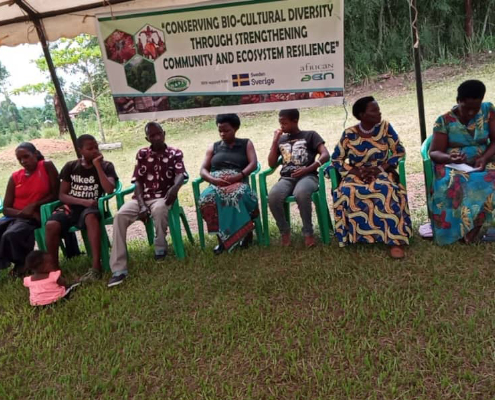
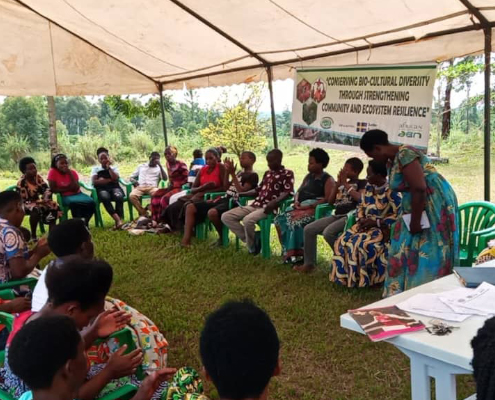
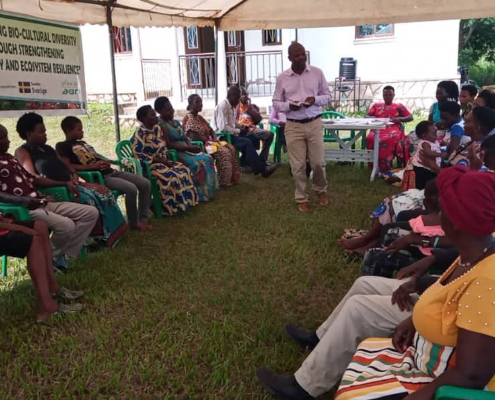
It promotes inclusivity, empowerment of local communities, and integrating indigenous knowledge, NAPE exemplifies these principles that are championed by the network. This collaborative, gender-balanced approach offers a replicable model for successful, community-driven conservation across Africa. During NAPEs journey of implementing the project on “Conserving Bio-Cultural Diversity through Strengthening Community and Ecosystem Resilience” there are some outputs that NAPE has been able to witness such as the revival of some indigenous seeds that had disappeared, for example, “empande” cross generation knowledge sharing where elders have had several meetings with youth to revive indigenous ways of interfacing with nature. Women in this project took an active role of ensuring that the issues of seeds are well dealt with and as the project’s phase come to an end, the communities have already established learning centers and mini seeds storage. Recently, seed catalogues are being developed in the communities of Kiboga, Kigaaga and Kihagya where this project has been running. During the course of implementation, a carbon trading group that works with NAPE and has been promoting tree planting in the agrarian land was published in the media. Now, communities have been given liberty to grow more trees as trees contribute to food sovereignty.
NAPE is a partner of ABN from Uganda and it is a part of the partners in the Eastern Sub Regional Node.